
Let's talk about something I bring up with almost every single client, because it explains SO much once it clicks: object permanence, basically, your brain's ability to remember something still exists even when you can't see it.Which is exactly why designing ADHD-friendly visible storage in your home matters so much more than chasing "neat and hidden away."
Now, before you picture a baby playing peekaboo, stick with me. I'm not talking about the developmental stage where infants learn that things still exist when they can't see them. I'm talking about the very real, very everyday version that shows up for a lot of ADHD brains: if it's not in view, it might as well not exist.
That charger in the drawer? Forgotten. Those birthday cards you bought "in advance" and put in a cupboard? Never sent. The good moisturiser you tucked away safely so it wouldn't get damaged? You'll buy a second one in three months because you genuinely forgot you owned it. Sound familiar?
This isn't forgetfulness in the way people think
Here's the plain-language version: your brain isn't holding a constant mental inventory of everything you own and where it lives. For a lot of us, that's mostly automatic. We glance at a cupboard, and some quiet part of the brain keeps track of "yes, the spare batteries are still in there." ADHD brains often don't do that background tracking reliably. Once something's behind a door, it drops out of working memory. Not because you don't care about it. Because your brain isn't built to keep tabs on things it can't currently see.
Which means all that lovely advice about hiding clutter away in matching boxes? It's not just unhelpful, it can actively work against you. You're not being tidy. You're building a memory palace with no map.
The core principle: visibility beats neatness
Let go of the idea that “organised” means “hidden.” For an ADHD brain, organised means visible. When you can see something, you remember it exists and are more likely to use it instead of buying a duplicate or letting it expire in a drawer.
So, the goal isn't to make everything disappear behind cupboard doors. It's to make sure the things you need to remember are sitting right there in your eyeline, doing the remembering for you.
Tactics that actually work
Here's what I put into practice in real homes, every week:
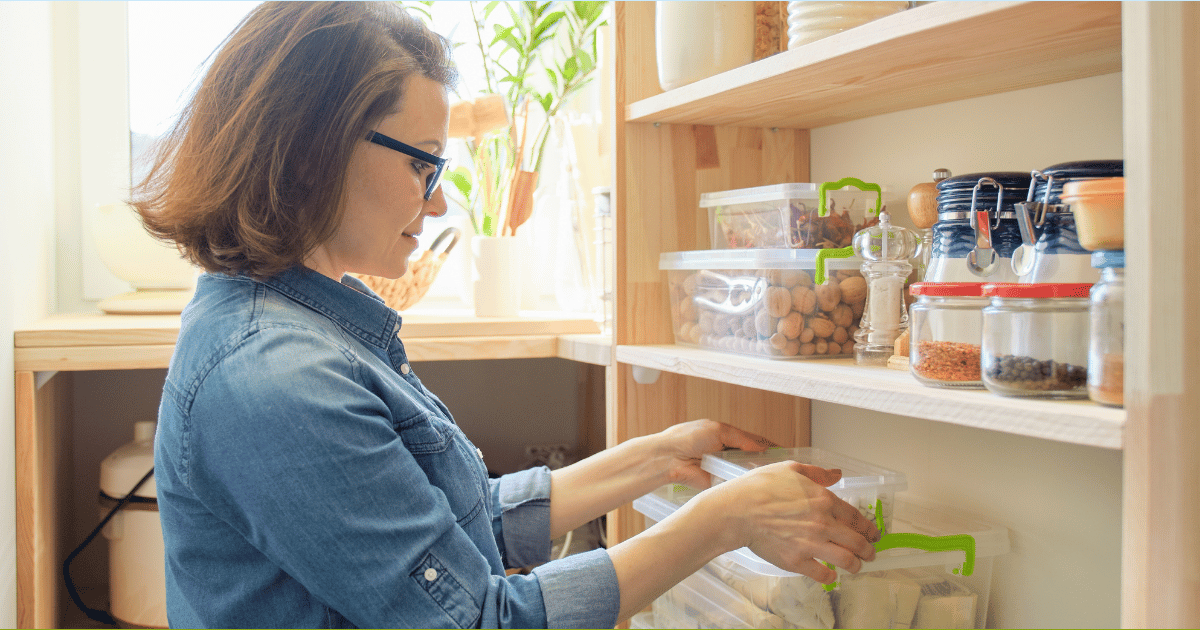
- Clear containers over solid ones. Same storage, completely different outcome. A clear bin lets your eyes do the inventory check for you, no opening, no guessing, no "I know it's in here somewhere."
- Open shelving where you can manage it. Not every room needs to look like a display case, but for the things you use often, open shelving keeps them present in your daily line of sight instead of quietly disappearing.
- Label with words AND pictures. Text alone relies on you stopping to read it, a small ask, but still a step. A quick icon or photo lets your brain register "this is the one" almost instantly, especially useful for kids, for kitchens, or for anyone who's tired and running on autopilot.
- Keep frequently used items fully visible, always. Your everyday things, the ones you touch daily or weekly shouldn't be the ones tucked furthest away "to keep things looking neat." Prioritise visibility exactly where the frequency is highest.
But how do you stay visible without it looking like chaos?
This is the bit people worry about most, and fair enough, nobody wants their kitchen looking like a stockroom. The trick isn't to hide things again. It's to bring in a bit of visual order that doesn't rely on your memory to work:
- Group by category or activity. Baking things together, tech cables together, art supplies together. Grouped clutter reads as "organised." Scattered clutter reads as "mess", even if it's the exact same number of items.
- Use colour intentionally. Matching bins, baskets, or labels in a small, consistent colour palette instantly makes an open shelf look curated rather than cluttered, without adding a single closed door.
- Create zones, not just spots. A "morning zone" for keys, bag, and coat. A "craft zone" for all the bits and bobs. Zones give visible storage a sense of logic, so it feels considered rather than random even though every single item is still in full view.
Visibility and calm aren't opposites. You just need a little structure holding the visible stuff together, rather than a door hiding it away.
Curious what a fully visible, ADHD-friendly system could look like in your home? [Get in touch and let's have a chat about your space.]